
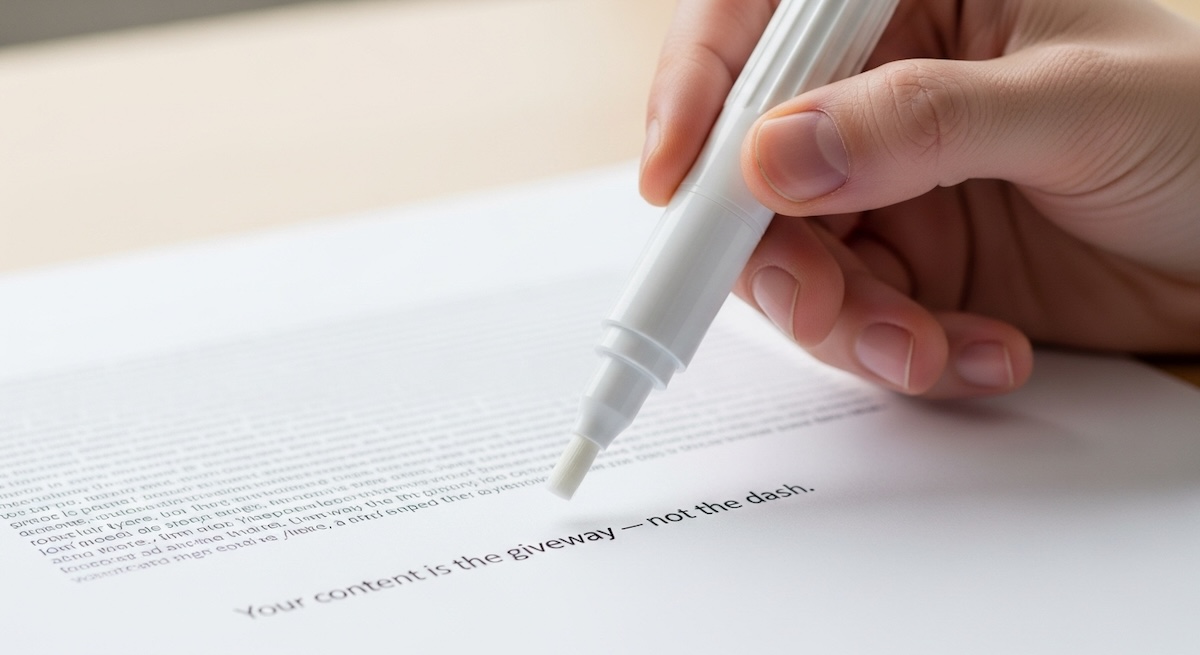
Sam Altman just posted that if you tell ChatGPT not to use em dashes — it finally listens.
A small-but-happy win, apparently.
But it got us thinking: why are we so desperate to hide the signs that we use AI at all?
I was talking to a customer the other day who told me they go through everything they write and change all the long dashes back to short ones.
“I don’t want people to know I used AI,” they said.
That hit me. Because I used to do the same thing — tidying up what the AI had produced.
I didn’t want anyone to think a machine had written my thoughts.
Funny, really. So many of us are heavy AI users, but we pretend we’re not.
We tell ourselves it’s just helping, not writing.
But what exactly are we hiding from?
Do we also not want people to know we use spell check?
Or that Word fixes our grammar before we hit send?
We don’t apologise for using spell check or grammar tools — they make us better.
So why do we apologise for using AI?
Maybe it’s because there’s a lot of AI slop flooding our feeds. But here’s the thing:
Good content has always risen above the noise because of the idea, not the formatting.
When I’m reading something sharp, human, and clear, I couldn’t care less if it used an “AI dash”.
But when it’s fluff dressed up as thought leadership, that dash becomes the giveaway.
Are we worried people will think we’re lazy? Or not as smart as we appear?
Maybe it’s time we admit that the tools we use don’t diminish our intelligence — they amplify it.
At some point, I stopped fighting it.
I let the em dash stay.
And when I finally looked it up — through my finest boomer research method (Google) — I realised it wasn’t wrong. It was the right one.
The em dash connects ideas without asking for permission.
It doesn’t pause to check for grammar or tidy things up — it just flows.
That’s why we’re EM dash people.
At EQOS, we think the same way.
AI shouldn’t flatten human expression into bullet points or strip out personality for the sake of structure.
It should move with us — fluid, connected, and responsive to how people actually think and work.
Every organisation has its own rhythm: the quirks, habits, and shortcuts that make things run.
We design AI that learns those patterns and fits in naturally.
Not to replace human logic, but to recognise it.
When we say AI-native, that’s what we mean.
Not “built by AI.” Built with it — alongside the people who use it, in the context of how they already work.
Governance keeps it steady. Design keeps it human.
And somewhere between the two sits the em dash — the bridge between ideas, systems, and people.
You might notice the occasional stylistic quirk — an em dash where an en dash might traditionally appear,
or phrasing that feels a little unconventional.
We leave these in deliberately, because we believe in normalising AI-assisted work.
It’s not about errors; it’s about embracing the frontier of how content is created today.
What matters is that it’s fast, clear, effective, and authentically our style.
So if you spot one of those quirks, smile — you’re reading the future, not a typo.
So yes, we’re EM dash people.
And we’re not hiding it.